AI Infrastructure Fails When the Wrong Data Enters the Pipeline
Organizations are pushing hard to scale their AI initiatives to drive faster decisions, improve operational efficiency, and unlock new business value.
At the same time, AI infrastructure has become increasingly expensive and resource-intensive. GPU resources remain scarce, and enterprises face growing pressure to maximize the value of the AI workloads they deploy.
But here’s something most AI strategies still overlook: the data flowing into those pipelines is often ungoverned, unclassified, and full of risk. This raises some important questions:
- Can organizations actually get the right data into their AI pipelines?
- Is the data appropriate for AI training and inference?
- Are teams exposing the business to risk by feeding sensitive, duplicate, or unnecessary data into their models?
These challenges become even more important as AI infrastructure expands beyond centralized cloud environments into distributed GPU deployments, sovereign AI environments, edge infrastructure, remote operations, and regulated industries.
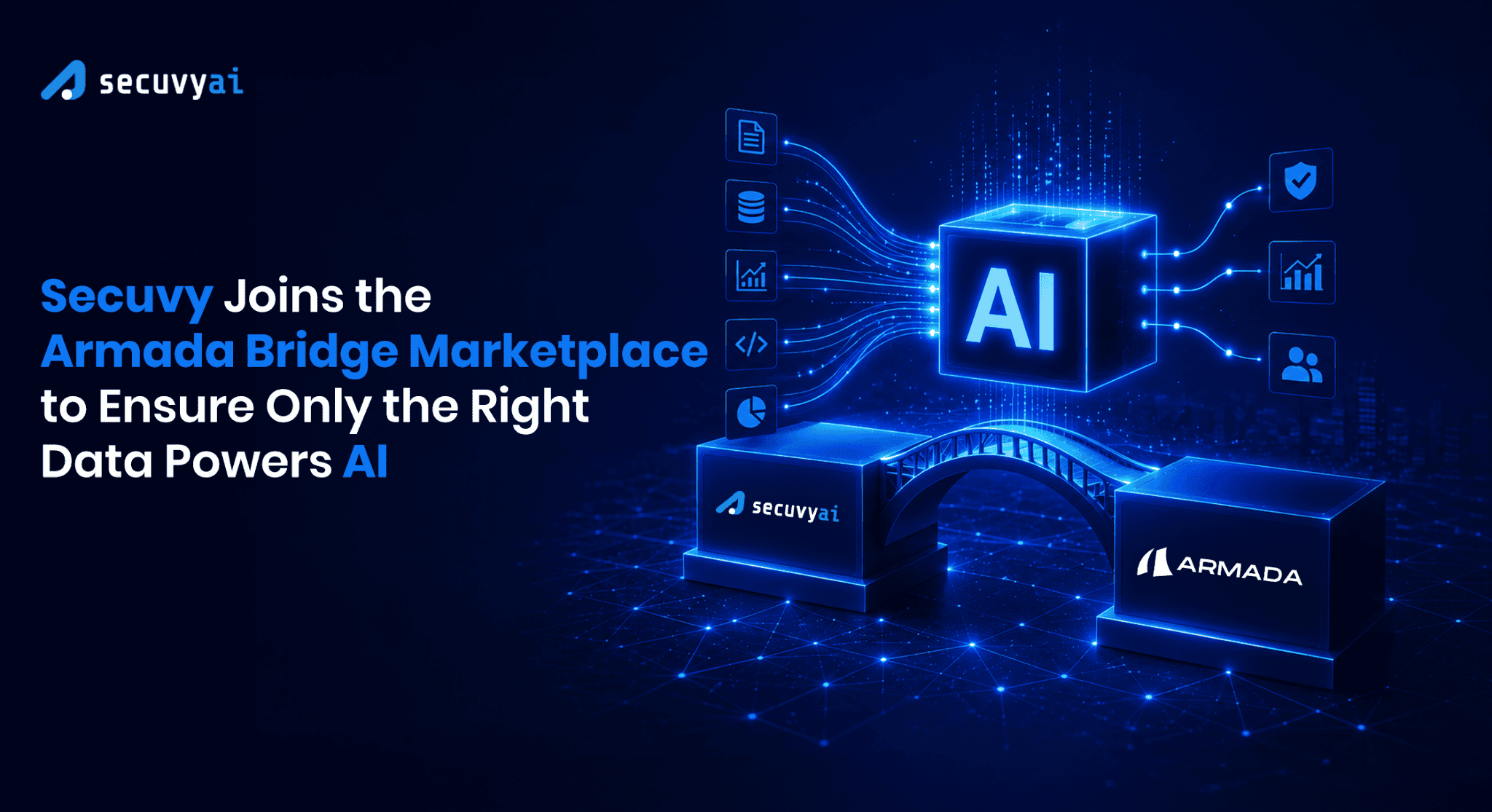
That is why Secuvy is joining the Armada Bridge Marketplace to ensure only policy-approved data powers AI from the ground up. Continue reading to know more about this partnership.
Why the Armada Bridge Marketplace Matters
Armada launched Bridge to help GPU operators move beyond raw compute and deliver production-ready AI services. Bridge provides a multi-tenant GPU-as-a-Service foundation with cloud-like orchestration, billing, and scale. The Marketplace expansion adds a validated software layer on top, covering orchestration, optimization, security, governance, and data management.
Secuvy is the founding data management partner in this ecosystem and the only data governance solution in the launch cohort.
According to Armada, the bottleneck in AI is no longer just access to GPUs or models. The operational layer surrounding AI infrastructure has become equally important. For organizations deploying AI at scale, that operational layer includes data governance, data filtering, data optimization, storage efficiency, and infrastructure utilization.
This is where Secuvy enters the stack. It sits at the data layer, continuously discovering, classifying, and filtering what enters AI training and inference workflows before it ever reaches a model.
The Hidden Problem Behind AI Workloads
Here’s the reality for most enterprise AI deployments today.
Teams spend weeks, sometimes months, on manual data preparation. They’re discovering datasets, cleansing records, staging files, and trying to figure out what’s sensitive and what’s safe to use. And even after all that effort, there’s rarely full confidence that the right data made it into the pipeline.
This creates three compounding problems:
Risk:
Organizations may unintentionally expose:
- Intellectual property
- Classified information
- PII
- PHI, and
- Other sensitive business data
in AI training and inference workflows. In regulated industries, that exposure carries real operational and compliance consequences.
Cost:
Without understanding what data is actually useful, organizations often feed excessive, duplicate, outdated, or erroneous data into expensive GPU systems, wasting:
- GPU cycles
- Tier 0 storage
- Infrastructure capacity
- AI investment dollars.
Large AI environments routinely consume massive compute and storage resources, processing data that provides little or no value to model outcomes.
The result is unnecessary GPU utilization, inflated storage costs, larger inference footprints, inefficient AI pipelines, and slower operational performance.
Time:
Manual data preparation remains one of the largest bottlenecks in AI development. Teams spend months discovering, cleansing, staging, and formatting datasets before workloads can move into production.
As AI environments become more distributed, these problems become significantly harder to manage consistently.
 See how Secuvy filters sensitive and unnecessary data before it reaches AI systems:
How Secuvy fits into the Stack
Armada Bridge operationalizes GPU infrastructure for AI workloads. Secuvy governs and filters the data entering those workloads. Together, we give organizations a complete path from raw compute to trusted, production-ready AI.
Armada describes Secuvy as “an AI-native platform for data security, privacy, and AI governance, purpose-built for data locality and sovereignty.” Armada also states that Secuvy “continuously discovers, classifies, and governs sensitive data across centralized and distributed clouds, all the way to the edge, via support for on-premises deployments.”
Secuvy delivers up to 99% classification accuracy, including for unstructured and context-heavy data types like:
- Intellectual property
- Engineering documentation
- Proprietary business information
- Classified operational data.
This goes far beyond traditional pattern-matching approaches that were designed primarily for structured identifiers like phone numbers, social security numbers, email addresses, and credit card formats.
Traditional classification tools were built for a different era.
Static rules and pattern matching miss sensitive data, generate excessive noise, and create uncertainty around whether organizations actually understand what is entering their AI systems.
Secuvy was purpose-built for environments where static rules and pattern matching fall short.
With Secuvy, organizations gain visibility into
- What data exists?
- Where does it live?
- How sensitive is it?
- Does it belong in AI workflows?
- What data is duplicate or unnecessary?
- What data is consuming expensive infrastructure resources?
Optimizing GPU and Storage Infrastructure Starts With the Data
AI infrastructure efficiency is directly tied to the quality of the data entering the system. When organizations cannot identify data that are duplicate, unnecessary, low-value, sensitive, or erroneous, they waste expensive infrastructure resources processing information that should never have entered the pipeline in the first place.
Secuvy changes that equation. By continuously discovering, classifying, and filtering data before it reaches AI systems, enabling organizations to:
- Reduce unnecessary GPU utilization
- Shrink Tier 0 storage footprints
- Eliminate duplicate datasets
- Decrease data movement
- Improve inference efficiency, and
- Increase the value of each GPU cycle.
This becomes even more important in distributed AI environments, sovereign AI deployments, edge infrastructure, high-cost GPU environments, and remote operational systems, where inefficient data pipelines directly impact operational cost and infrastructure scalability.
Learn how Secuvy optimizes AI infrastructure efficiency:
Policy-Approved Data for AI Training and Inference
Armada states that Secuvy:
“Uses AI- and ML-powered filtering to ensure only policy-approved data flows into AI training and inference workflows.”
This is becoming a foundational requirement for organizations building AI infrastructure in regulated and distributed environments.
Secuvy enables organizations to:
- Identify sensitive data
- Reduce duplicate and unnecessary data
- Enforce governance policies
- Improve visibility into AI pipelines
- Reduce unnecessary GPU utilization
- Improve the quality of AI-ready datasets
The result is greater confidence that AI systems are operating on the right data.
How Secuvy Works Alongside Armada Bridge
Bridge operationalizes GPU infrastructure for AI workloads. Secuvy governs and filters the data entering those workloads. Together, the two platforms give organizations a complete path from raw compute to trusted, production-ready AI.
Secuvy was purpose-built for environments where static policies and pattern matching alone are not enough. The platform’s core capabilities include:
Self-Learning Filtering
Secuvy continuously discovers and auto-classifies data using a self-learning, unsupervised AI engine that adapts to real content and context. There is no manual tagging, no regex tuning, and no retraining required.
Non-Pattern Data Classification
Secuvy does not rely exclusively on pattern-based classification. Organizations define the need, and Secuvy identifies it in the data.
Contextual Linkage
Secuvy connects sensitive data to the business context in which it exists, including users, systems, access paths, and governing policies. This correlation improves classification accuracy and visibility.
AI-Aware Governance
Secuvy treats AI as a data access layer that must be governed using real data context, not just surface-level rules.
Why This Matters for Distributed and Edge AI
As organizations deploy AI closer to their operations, governance and visibility become increasingly important.
Defense and Aerospace
Defense and aerospace organizations operate in environments with strict requirements around CMMC, ITAR, classified data, and sovereign infrastructure. Secuvy continuously discovers and governs sensitive data before it enters AI workflows, helping these organizations maintain compliance across distributed environments.
Oil, Gas, and Industrial Operations
Industrial and energy organizations increasingly use AI to improve predictive maintenance, operational efficiency, remote operations, and automation. These environments generate massive amounts of operationally sensitive data that must be governed appropriately before entering AI systems.
Distributed AI Infrastructure
Organizations deploying AI across distributed GPU environments need visibility into the data entering AI systems across both centralized and edge deployments. Secuvy provides that visibility continuously.
The Outcome: Lower Risk, Lower Cost, Faster AI
Secuvy addresses some of the biggest operational challenges in AI data today.
Lower Risk
Secuvy ensures organizations know exactly what is entering AI systems, reducing exposure to:
- PII
- PHI
- Intellectual property
- Classified information
Lower Cost with Better Data
Secuvy reduces:
- Manual cleansing effort
- Duplicate data
- Erroneous data
- Unnecessary GPU utilization
- Excessive Tier 0 storage consumption
Faster Time to Market
Reducing manual data preparation accelerates AI deployment timelines and enables organizations to operationalize AI faster.
Learn how Secuvy reduces AI data risk and infrastructure waste:
Building Confidence in AI Pipelines
As AI adoption accelerates, organizations need confidence in the data that powers their AI systems. Secuvy provides a trusted data bill of materials (dBOM) so organizations can understand exactly what data is fueling their AI pipelines at any point in time.
Armada Bridge provides the GPU infrastructure foundation for AI workloads.
Secuvy ensures that only policy-approved data flows into those AI training and inference environments.
Together, Armada and Secuvy enable organizations to operationalize AI with greater visibility, stronger governance, improved GPU efficiency, optimized storage utilization, reduced infrastructure waste, and greater confidence.
Ready to See Secuvy in Action?
If your organization is building AI infrastructure and needs visibility into the data entering AI training and inference workflows:
Schedule a Demo: secuvy.ai/demo
Learn More About the Armada Bridge Marketplace: armada.ai/blog/bridge-marketplace-launch-new-partners